
Have you been told you need spine surgery? If your immediate reaction is intense anxiety, you are certainly not alone. The human spine is a masterpiece of biological engineering, but it is also incredibly delicate. It houses the spinal cord and millions of nerve fibers, acting as the primary information highway for your entire body. For decades, the thought of someone operating near these critical pathways has terrified patients, leading many to delay necessary care.
However, modern medicine has completely changed the landscape of orthopedic and neurosurgery. Imagine if a surgeon could use a real-time, high-definition tracking system—just like the satellite navigation on your smartphone—to guide their tools with millimeter-level accuracy. This is no longer science fiction. It is the reality of advanced medical technology today.
In this comprehensive guide, we are going to explore exactly what this technology is. We will dive deep into GPS for Your Spine: What Surgical Navigation Means for your physical safety, your post-operative recovery, and your long-term mobility. Whether you are dealing with a severe herniated disc, debilitating spinal stenosis, or a traumatic sports injury, understanding your surgical options is your first step toward true healing.
Furthermore, if you live in Gujarat, you no longer have to travel hundreds of miles for world-class medical care. Finding the best spine surgeon in Vadodara who utilizes this cutting-edge technology is easier than ever. Let’s break down exactly how this “surgical GPS” works, how it compares to older methods, and why it is rapidly becoming the gold standard for spine care.
Table of Contents
-
What Exactly is Surgical Navigation for the Spine?
-
Traditional Surgery vs. Navigation-Assisted Surgery (A Direct Comparison)
-
5 Proven Benefits: What Surgical Navigation Means for Patients
-
Why Vadodara is Becoming a Hub for Advanced Spine Care
-
Ideal Candidates: Who Needs Spine Navigation Surgery?
-
The Step-by-Step Guide to the Procedure
-
Frequently Asked Questions (FAQs)
-
Conclusion
-
Take the Next Step Toward a Pain-Free Life
1. What Exactly is Surgical Navigation for the Spine?
To understand surgical navigation, think about how you drive to an unfamiliar city. In the past, you would rely on a paper map. You had a general idea of where you were going, but you couldn’t see traffic jams, roadblocks, or exactly where your car was in real-time. Today, you use a GPS app that shows your vehicle as a moving dot on a digital map, guiding you turn-by-turn.
Surgical navigation does the exact same thing for a spine surgeon. Before the procedure, the patient undergoes advanced imaging, such as a CT scan or a high-resolution MRI. These scans are fed into a powerful computer that builds a highly detailed, 3D model of the patient’s unique spinal anatomy.
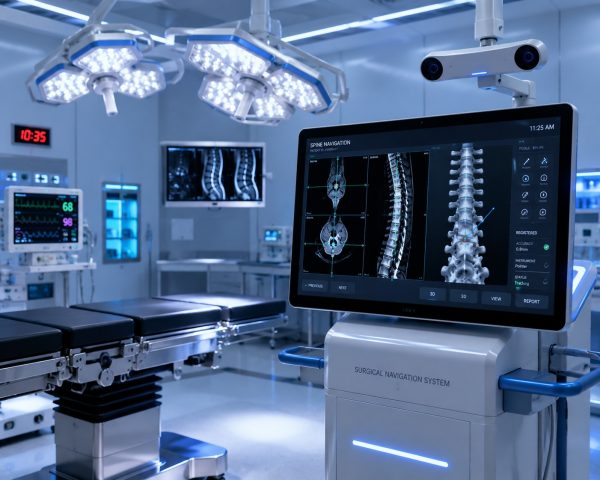
During the surgery, specialized tracking devices are placed on the surgical instruments and the patient’s spine. Cameras in the operating room read these trackers and sync them with the 3D computer model. As the surgeon moves their instruments, they can look at a monitor and see the exact trajectory of their tools inside the patient’s body in real-time. This eliminates the guesswork and allows the surgeon to navigate around critical nerves and blood vessels safely.
2. Traditional Surgery vs. Navigation-Assisted Surgery (A Direct Comparison)
When considering spine treatment in Vadodara, it is crucial to understand how modern techniques stack up against traditional methods.
Traditional Spine Surgery (The “Open” Method)
Historically, spine surgery required the surgeon to make a large incision down the center of the back. They had to strip away a significant amount of muscle and tissue just to visibly see the spine. To ensure screws and implants were placed correctly, surgeons relied on their anatomical knowledge and continuous, live X-rays (fluoroscopy) taken throughout the operation.
While effective, this method has drawbacks. Large incisions mean more blood loss, greater tissue damage, and a highly painful, prolonged recovery. Furthermore, relying on 2D X-rays to navigate a 3D space leaves a small margin for human error, and exposes both the patient and the surgical team to high levels of radiation.
Navigation-Assisted Spine Surgery
With surgical navigation, the game changes entirely. Because the surgeon can see a 3D map of the spine on a monitor, they do not need to make a massive incision to expose the bone. They can perform the entire operation through a few tiny, keyhole incisions.
-
Visibility: Traditional relies on direct eyesight and 2D X-rays; Navigation uses a real-time, 3D computer map.
-
Incision Size: Traditional requires a large, invasive cut; Navigation uses minimally invasive, small punctures.
-
Radiation: Traditional uses heavy, continuous X-rays; Navigation dramatically reduces radiation exposure.
-
Accuracy: Traditional relies heavily on the surgeon’s physical spatial awareness; Navigation provides sub-millimeter digital guidance.
3. 5 Proven Benefits: What Surgical Navigation Means for Patients
Understanding GPS for Your Spine: What Surgical Navigation Means is best done by looking at the tangible benefits it offers to you, the patient.
1. Pinpoint Accuracy for Implants
Spinal fusion surgeries often require the placement of screws and rods to stabilize the spine. Placing a screw even a millimeter off-course can irritate a nerve or compromise the spinal cord. Surgical navigation boasts an accuracy rate of over 95%, ensuring that every piece of hardware is perfectly positioned.
2. Drastically Reduced Risk of Nerve Damage
Because the surgeon has a clear map of your neural pathways, they can navigate around them seamlessly. The real-time tracking acts as an early warning system, preventing accidental contact with delicate spinal nerves.
3. Smaller Incisions and Minimal Blood Loss
Since the surgeon does not need to expose the entire spine, the surrounding muscles are gently pushed aside rather than cut. This minimally invasive approach leads to significantly less bleeding during the operation and far less post-operative pain.
4. Faster, Smoother Recovery Times
Less trauma to your muscles means your body can focus entirely on healing the spine itself. Patients who undergo navigation-assisted surgery often leave the hospital days earlier than traditional surgery patients and return to their normal daily activities much faster.
5. Lower Revision Rates
When hardware is placed perfectly the first time, the chances of needing a second “revision” surgery drop drastically. This gives patients peace of mind knowing their spinal issue has been resolved permanently.
4. Why Vadodara is Becoming a Hub for Advanced Spine Care
For decades, patients facing complex spinal surgeries believed they had to travel to major metropolitan hubs like Mumbai, Delhi, or even abroad to receive top-tier care. This required expensive flights, long hotel stays, and the stress of recovering far away from the comfort of home.
Today, the healthcare landscape in Gujarat has transformed. You can now find a world-class spine specialist in Vadodara equipped with the exact same high-end surgical navigation technology found in international hospitals.
Choosing local treatment in Vadodara offers distinct advantages. First, the accessibility of care means less physical strain on a patient already suffering from severe back pain. Traveling with a bad back is excruciating; having a state-of-the-art facility in your own city is a massive relief. Second, recovering near home means your family and primary support network are right by your side. Finally, the overall cost of treatment—factoring in the elimination of travel and accommodation expenses—makes advanced spine care significantly more accessible to the local population.
5. Ideal Candidates: Who Needs Spine Navigation Surgery?
Not every back ache requires surgery. In fact, most top specialists will recommend conservative treatments like physical therapy or medication first. However, when conservative methods fail, navigation-assisted surgery becomes an incredible option.
You may be a candidate for this advanced procedure if you suffer from:
-
Severe Herniated Discs: When the soft cushion between your vertebrae ruptures and presses severely against your spinal nerves.
-
Spinal Stenosis: A condition where the spinal canal narrows, putting immense pressure on the spinal cord.
-
Scoliosis or Kyphosis: Complex deformities where the spine curves abnormally, requiring precise reconstruction and stabilization.
-
Spinal Fractures: Broken vertebrae caused by trauma or severe osteoporosis that need immediate, accurate stabilization.
-
Spinal Tumors: Removing growths near the spine requires extreme precision to avoid damaging healthy nerve tissue.
If you are experiencing radiating pain down your legs (sciatica), numbness, tingling, or a loss of bowel/bladder control, you should consult a specialist immediately to discuss your spine treatment options.
6. The Step-by-Step Guide to the Procedure
Walking into an operating room is intimidating, but knowing exactly what happens can significantly reduce your fear. Here is a breakdown of how the procedure unfolds when guided by surgical navigation:
Step 1: The Pre-Operative Map Before you even enter the operating room, you will undergo a specialized CT or MRI scan. This scan is the foundation of your surgical map, providing the computer with all the data it needs to build your 3D model.
Step 2: Calibration and Syncing Once you are comfortably under anesthesia, the surgeon attaches a small tracking array to a stable point on your spine. They then touch specific anatomical landmarks on your back with a registered probe. This syncs your physical body to the digital 3D map on the computer.
Step 3: Real-Time Navigation The surgeon makes a tiny incision. As they insert their surgical tools, the instruments—which also have trackers on them—appear on the computer screen. The surgeon watches the screen to guide their tools with flawless accuracy directly to the problem area.
Step 4: Execution and Verification Whether they are removing a bone spur or placing a titanium screw, the surgeon uses the digital map to ensure perfect execution. Before closing the incision, the system can perform a final quick scan to verify that everything is perfectly in place.
7. Frequently Asked Questions (FAQs)
Is surgical navigation safe? Yes, it is exceptionally safe. In fact, it was designed specifically to increase safety. By providing real-time 3D visualization, it actively prevents the surgeon from making errors and keeps their instruments far away from critical nerves.
How do I find the best spine surgeon in Vadodara for this procedure? Look for a board-certified orthopedic spine surgeon or neurosurgeon who explicitly mentions “minimally invasive spine surgery” (MISS) and “image-guided navigation” in their credentials. Checking patient testimonials and hospital accreditations in Gujarat will also guide you to the right expert.
Will I have a large scar on my back? No. One of the greatest benefits of this technology is that it allows the surgeon to operate through very small keyhole incisions. Your scars will be minimal, often just an inch or two long, and will fade significantly over time.
Is spine treatment in Vadodara on par with metropolitan cities? Absolutely. The top tier hospitals in Vadodara utilize the exact same robotic and navigation systems found in Mumbai, Delhi, and top global institutions. You receive international-standard care without the burden of long-distance travel.
8. Conclusion
Deciding to undergo spine surgery is one of the most significant health choices you will ever make. It is completely natural to feel hesitant. However, the introduction of advanced technological tools has fundamentally altered the risk profile of these procedures.
Understanding GPS for Your Spine: What Surgical Navigation Means empowers you to take control of your health journey. It means choosing precision over guesswork. It means opting for small incisions instead of major trauma. Most importantly, it means choosing a safer path that gets you back on your feet and back to living your life quickly and comfortably.
With world-class facilities right here in Gujarat, you do not need to compromise on your care. You have access to the finest medical technology and the most skilled hands right in your own community.
9. Take the Next Step Toward a Pain-Free Life
You do not have to let chronic back pain dictate the terms of your life. If you are struggling with mobility, nerve pain, or a diagnosed spinal condition, it is time to explore your advanced surgical options.
Reach out today to schedule a consultation with the leading spine specialist in Vadodara. During your visit, the medical team will evaluate your specific condition, explain how surgical navigation can be tailored to your unique anatomy, and map out a clear, confident path to your recovery. Don’t wait until the pain becomes unbearable—contact us now and take your first step toward a stronger, healthier spine.
