
Back pain is an epidemic that affects millions of people worldwide, from young professionals to active seniors.
However, many people do not realize that the secret to a healthy back is not just resting it, but actively strengthening the muscles around it.
Your core acts as a natural corset, holding your vertebrae in place and absorbing the shocks of daily movements.
If you want to avoid frequent visits to a clinic, implementing daily core exercises to protect your spine is the smartest preventative measure you can take.
Whether you are navigating the busy streets of Vadodara or sitting at a desk all day, building a strong foundation is absolutely essential for your long-term mobility.
In this comprehensive guide, we will break down three highly effective, low-impact movements designed to build an indestructible core.
Table of Contents
- The Hidden Connection Between Your Core and Your Spine
- Why Vadodara Residents Need Spinal Protection
- Pre-Exercise Checklist: Setting Up for Success
- 3 Daily Core Exercises to Protect Your Spine from Injury
- Exercise 1: The Bird-Dog
- Exercise 2: The Modified Forearm Plank
- Exercise 3: The Glute Bridge
- The Benefits of a Consistent Core Routine
- When to Seek Professional Spine Treatment in Vadodara
- Why Choose Vadodara for Your Spine Health?
- Frequently Asked Questions (FAQs)
- Conclusion: Take Charge of Your Spinal Health
The Hidden Connection Between Your Core and Your Spine
When most people think of their “core,” they immediately picture abdominal muscles or a six-pack.
However, your core is actually a complex, three-dimensional cylinder of muscles encompassing your entire trunk.
This includes your abdominal muscles, your obliques, your pelvic floor, and the vital erector spinae muscles in your back.
These muscles work in harmony to stabilize your spine during every single movement you make.
When your core is weak, your spine is forced to take on the entire burden of lifting, twisting, and bending.
Over time, this lack of muscular support leads to compressed discs, strained ligaments, and debilitating pain.
By practicing daily core exercises to protect your spine, you are effectively building a muscular shield around your vertebrae.
Why Vadodara Residents Need Spinal Protection
Modern living takes a massive toll on our spinal health, and this is especially true in fast-growing cities.
In Vadodara, a combination of rapid urbanization, desk-bound corporate jobs, and long commutes contributes to rising back issues.
Riding two-wheelers on uneven roads or sitting through heavy traffic can place repetitive micro-stresses on the lower back.
Consequently, the demand for a qualified spine specialist in Vadodara has skyrocketed over the past decade.
Many patients walk into clinics suffering from injuries that could have been entirely prevented with basic core conditioning.
Preventative care through daily movement is far more effective and affordable than waiting for a severe injury to occur.
Pre-Exercise Checklist: Setting Up for Success
Before jumping into the exercises, it is crucial to prepare your body and your environment.
Doing exercises with improper form can actually cause more harm than good, defeating the entire purpose of the routine.
Follow these simple steps before you begin:
-
Find a Flat Surface: Use a high-quality yoga mat on a hard, flat floor. Avoid doing these exercises on a soft mattress, as it compromises your spinal alignment.
-
Wear Comfortable Clothing: Wear breathable, stretchable fabrics that do not restrict your movement or pinch your waist.
-
Warm-Up First: Spend 3-5 minutes doing light stretches or walking in place to increase blood flow to your muscles.
-
Focus on Breathing: Never hold your breath during core exercises. Inhale during the relaxation phase and exhale during the exertion phase.
3 Daily Core Exercises to Protect Your Spine from Injury
These three low-impact movements are carefully selected because they strengthen the stabilizing muscles without putting dangerous pressure on the vertebral discs.
Exercise 1: The Bird-Dog
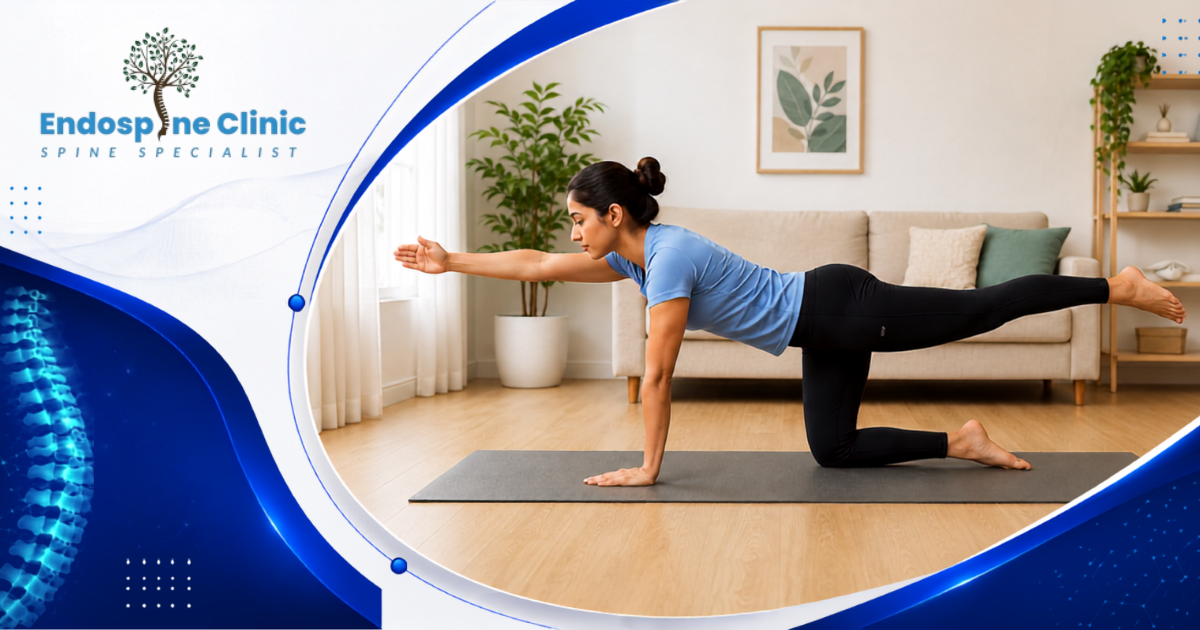
The Bird-Dog is widely considered one of the best daily core exercises to protect your spine.
It teaches your body to stabilize the lumbar spine while you move your arms and legs.
This is incredibly important for improving coordination and preventing sudden tweaks during daily chores.
How to perform the Bird-Dog:
-
Begin on your hands and knees in a tabletop position.
-
Ensure your hands are directly under your shoulders and your knees are under your hips.
-
Keep your back flat like a table and your gaze pointed down at the mat to maintain a neutral neck.
-
Slowly extend your right arm straight out in front of you while simultaneously extending your left leg straight behind you.
-
Hold this extended position for 3 to 5 seconds, focusing on keeping your hips completely level.
-
Slowly return to the starting tabletop position.
-
Repeat on the opposite side (left arm and right leg).
Recommended Routine: Perform 2 sets of 10 repetitions on each side.
Pro-Tip: Imagine balancing a glass of water on your lower back. If you twist your hips, the water will spill.
Exercise 2: The Modified Forearm Plank
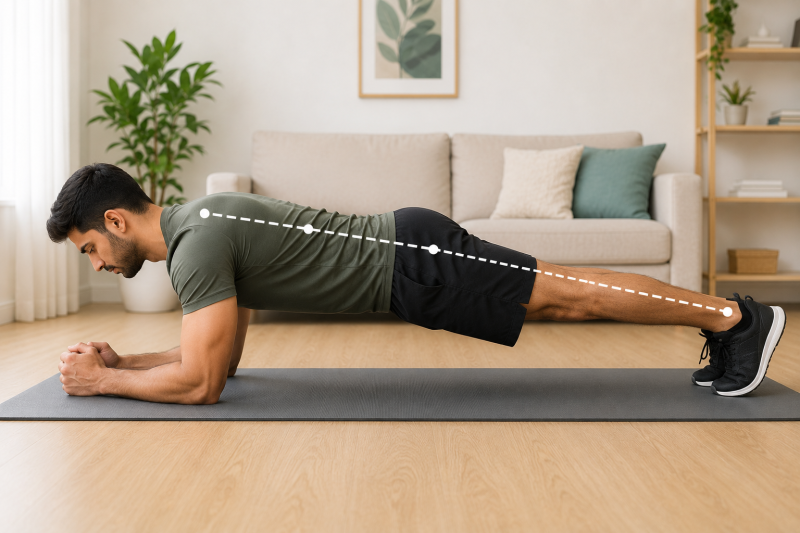
While traditional sit-ups can actually damage your spinal discs, the plank builds isometric strength safely.
The forearm plank engages the deep transverse abdominis, which acts like a muscular weightlifting belt.
We recommend the modified version (on the knees) for beginners to ensure zero strain on the lower back.
How to perform the Modified Forearm Plank:
-
Lie face down on your mat.
-
Prop yourself up on your elbows, ensuring your elbows are directly beneath your shoulders.
-
Keep your knees resting on the floor, but lift your hips so your body forms a straight line from your head to your knees.
-
Brace your core tightly, exactly as if you were preparing for someone to punch you in the stomach.
-
Squeeze your glutes to prevent your lower back from sagging toward the floor.
-
Hold this rigid position while breathing deeply and evenly.
Recommended Routine: Hold the plank for 20 to 30 seconds. Rest for 15 seconds. Repeat 3 times.
Pro-Tip: As your core strength improves over a few weeks, you can progress to a full plank by lifting your knees off the ground.
Exercise 3: The Glute Bridge
Your glutes (buttocks) are directly connected to your pelvis and lower back.
When your glutes are weak—often due to sitting all day—your lower back overcompensates, leading to pain.
The Glute Bridge is a phenomenal, low-impact way to strengthen both the glutes and the erector spinae muscles.
How to perform the Glute Bridge:
-
Lie flat on your back with your knees bent and your feet planted firmly on the floor, hip-width apart.
-
Rest your arms down by your sides with your palms facing the floor.
-
Press firmly into your heels and squeeze your glutes.
-
Slowly lift your hips up toward the ceiling until your body forms a straight line from your knees to your shoulders.
-
Avoid pushing your hips too high, as this can artificially arch and compress the lower back.
-
Hold the top bridge position for 2 to 3 seconds.
-
Slowly and with control, lower your hips back down to the starting position on the mat.
Recommended Routine: Perform 3 sets of 12 to 15 repetitions.
Pro-Tip: Focus entirely on using your glute muscles to lift your body, rather than pushing up with your lower back or hamstrings.
The Benefits of a Consistent Core Routine
Consistency is the ultimate key to unlocking spinal health.
Doing these daily core exercises to protect your spine once a month will not yield results; they must become a daily habit.
When performed regularly, patients experience a dramatic reduction in stiffness and morning backaches.
Furthermore, a strong core improves your posture, making you stand taller and look more confident.
It also drastically reduces the risk of acute injuries, such as herniated discs or muscle spasms from sudden movements.
Ultimately, investing 10 minutes a day into your core can save you months of painful recovery down the line.
When to Seek Professional Spine Treatment in Vadodara
While daily exercises are excellent for prevention and minor aches, they are not a cure-all for severe conditions.
If you are experiencing sharp, shooting pain down your legs, numbness, or tingling, you must stop exercising immediately.
These are red flags indicating nerve compression, which requires immediate medical evaluation.
In such cases, finding the best spine surgeon in Vadodara is crucial for an accurate diagnosis.
Modern diagnostics, such as high-resolution MRI scans, allow specialists to pinpoint exactly what is causing your pain.
Do not attempt to “push through” severe pain with exercises, as this can worsen underlying structural damage.
Why Choose Vadodara for Your Spine Health?
Vadodara has rapidly emerged as a premier medical hub in Gujarat for orthopedic and spinal care.
Patients from surrounding towns and even neighboring states travel here specifically for advanced spine treatment in Vadodara.
The city boasts state-of-the-art hospitals equipped with minimally invasive surgical technology.
Moreover, patient accessibility in Vadodara is excellent, with world-class clinics located conveniently across the city.
The trust factor is incredibly high, as many local specialists have international training and decades of proven experience.
Whether you need physical therapy guidance or advanced surgical intervention, Vadodara provides comprehensive, compassionate care.
Frequently Asked Questions (FAQs)
1. How often should I do daily core exercises to protect my spine? For maximum benefit, these low-impact movements should be done daily. Since they are not high-intensity, your muscles do not require long recovery periods. Just 10-15 minutes a day is enough to build meaningful spinal stability.
2. Can these exercises cure existing, severe back pain? No. While they are excellent for prevention and managing mild, muscular aches, they cannot cure structural issues like severe disc herniations. If you are in severe pain, you should immediately consult a spine specialist in Vadodara before starting any routine.
3. I feel a slight burn in my muscles when doing these; is that normal? Yes, a mild muscular “burn” or fatigue in your abdomen or glutes is completely normal and indicates the muscles are working. However, if you feel sharp, shooting pain in your spine or joints, stop immediately.
4. How long does it take to see results from these core exercises? Most people begin to feel a noticeable difference in their posture and a reduction in daily stiffness within 2 to 4 weeks of consistent practice. Long-term structural protection builds continuously over months of regular exercise.
5. Are these movements safe for older adults? Absolutely. The Bird-Dog, Modified Plank, and Glute Bridge are specifically chosen because they are extremely low-impact. They do not involve twisting or heavy weights, making them ideal and safe for older adults looking to maintain their mobility.
Conclusion: Take Charge of Your Spinal Health
Your spine is the central pillar of your entire body, and protecting it should be a top priority in your daily life.
By integrating these 3 daily core exercises to protect your spine, you are actively investing in your future mobility and comfort.
Remember, prevention is always easier, cheaper, and less painful than finding a cure after an injury occurs.
Start slow, focus entirely on your form, and make these movements a non-negotiable part of your daily routine.
Your back supports you every single day; it’s time you return the favor by giving it the muscular support it deserves.
Ready to Live Pain-Free?
If you are struggling with persistent back pain that isn’t resolving with rest or exercise, it’s time to get professional help. Don’t let back pain dictate your life or limit your daily activities.
Book a consultation with the best spine surgeon in Vadodara today. Our dedicated team of specialists is ready to provide you with a customized, comprehensive care plan to get you back on your feet.
Contact us now to schedule your appointment and take the first step toward a healthier, stronger spine!
