
Are you struggling with a sharp, shooting pain radiating from your lower back down to your legs? If so, you are likely experiencing sciatica, a condition that affects millions of people globally.
When the pain strikes, your first instinct might be to stay in bed and avoid movement entirely. However, the relationship between sciatica and exercise is widely misunderstood. Complete bed rest can actually make your symptoms worse by stiffening your muscles and weakening your spine.
In today’s fast-paced world, especially in a bustling medical hub like Vadodara, patients are increasingly looking for active, non-surgical ways to manage their back pain.
This comprehensive guide will explore the exact relationship between sciatica and exercise. We will break down the safest workouts to relieve your pain, the dangerous movements you must avoid, and how to find the right local care to get your life back on track.
Table of Contents
-
Understanding Sciatica and Exercise: Why Movement Matters
-
Sciatica Symptoms to Watch Out For
-
Sciatica and Exercise: 7 Safe Workouts for Instant Relief
-
Dangerous Movements: Exercises to Avoid with Sciatica
-
Local Care: Choosing the Best Spine Specialist in Vadodara
-
Modern Spine Treatment in Vadodara: What to Expect
-
Benefits and Expected Recovery Timeline
-
FAQs on Sciatica Exercises and Spine Health
-
Conclusion
Understanding Sciatica and Exercise: Why Movement Matters
Sciatica occurs when the sciatic nerve—the longest and thickest nerve in the human body—becomes pinched or irritated. This usually happens due to a herniated disc, bone spur, or spinal stenosis in the lower back.
When discussing sciatica and exercise, it is crucial to understand that targeted movement promotes healing. Exercise increases blood flow to the spinal discs and nerves, delivering the oxygen and nutrients necessary for tissue repair.
Furthermore, gentle physical activity helps release endorphins, which are the body’s natural painkillers. By keeping the muscles surrounding the spine strong and flexible, you reduce the pressure on the sciatic nerve.
According to leading health authorities, remaining sedentary can lead to muscle atrophy. For more detailed insights on how physical activity impacts nerve health.
Sciatica Symptoms to Watch Out For
Before diving into a workout routine, you must confirm that your symptoms align with sciatica. Misdiagnosing yourself can lead to performing the wrong exercises, which might exacerbate the issue.
Patients seeking spine treatment in Vadodara typically report the following common symptoms:
-
Radiating Pain: A distinct, burning pain that travels from the lower back, through the buttocks, and down the back of one leg.
-
Numbness or Tingling: A “pins and needles” sensation in the leg, foot, or toes.
-
Muscle Weakness: Difficulty lifting your foot or feeling instability when walking or standing.
-
Pain Worsened by Sitting: Prolonged sitting often compresses the sciatic nerve, causing flare-ups.
If you experience sudden loss of bowel or bladder control, this is a medical emergency. You should immediately seek out a trusted medical professional in your area.
Sciatica and Exercise: 7 Safe Workouts for Instant Relief
When managing sciatica and exercise, the goal is to mobilize the lower back, strengthen the core, and gently stretch tight muscles without overloading the spine.
Here are seven proven, safe exercises that you can incorporate into your daily routine.
1. Gentle Walking
Walking is one of the most natural and effective exercises for sciatic pain. It encourages a healthy stride and keeps the spinal joints mobile.
-
How it helps: It reduces inflammation and prevents the hamstring muscles from tightening up.
-
Tips for safety: Walk on flat, even surfaces. Avoid steep inclines or treadmill walking if it triggers pain.
-
Duration: Aim for 15 to 20 minutes of continuous, slow-paced walking daily.
2. Swimming and Water Aerobics
Water therapy is highly recommended by medical professionals across Gujarat. The buoyancy of the water completely removes the gravitational stress from your spine.
-
How it helps: It allows you to build strength and flexibility without any joint compression.
-
Tips for safety: Avoid twisting strokes like the butterfly. Stick to gentle freestyle or simply walking in waist-deep water.
-
Duration: 30 minutes, two to three times a week.
3. Core Strengthening Exercises (Bird-Dog)
A strong core acts like a natural corset, supporting your lower back and protecting the sciatic nerve from sudden jolts.
-
How it helps: The Bird-Dog exercise improves balance and strengthens the transverse abdominis.
-
Tips for safety: Start on your hands and knees. Extend one arm forward and the opposite leg backward. Keep your spine perfectly neutral.
-
Duration: Hold for 5 seconds. Repeat 10 times on each side.
4. Pelvic Tilts
The pelvic tilt is a foundational movement for anyone suffering from lower back issues. It helps realign the pelvis and stretches the lower back muscles.
-
How it helps: It relieves built-up tension in the lumbar spine.
-
Tips for safety: Lie on your back with knees bent. Tighten your stomach muscles and press your lower back flat into the floor.
-
Duration: Hold for 10 seconds. Do 10 to 15 repetitions.
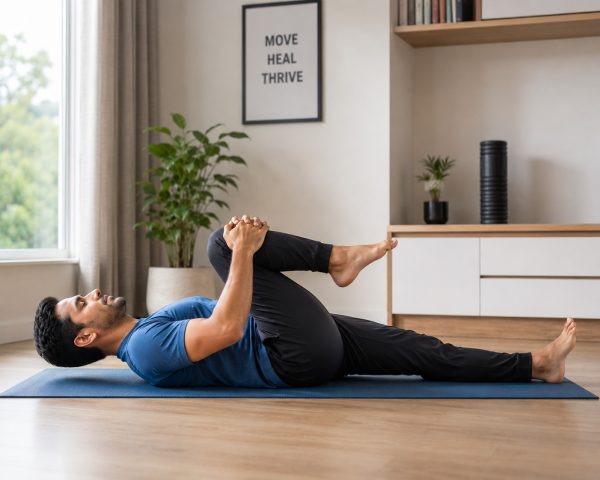
5. Knee-to-Chest Stretches
Tight glutes and piriformis muscles can directly squeeze the sciatic nerve. This gentle stretch releases that exact tension.
-
How it helps: Opens up the lower back and stretches the deep gluteal muscles.
-
Tips for safety: Lie flat, pull one knee gently toward your chest until you feel a comfortable stretch. Do not force it.
-
Duration: Hold for 20 to 30 seconds per leg.
6. Stationary Cycling
If walking causes too much nerve irritation, stationary cycling is a fantastic alternative for cardiovascular health.
-
How it helps: It provides a great lower-body workout without the high impact of running.
-
Tips for safety: Use a recumbent bike rather than an upright bike. The backrest provides essential lumbar support.
-
Duration: 15 to 20 minutes at a low resistance.
7. Modified Yoga (Child’s Pose)
Yoga can be incredibly beneficial for sciatica, provided you avoid extreme forward folds or deep twists.
-
How it helps: Child’s Pose gently lengthens the spine and relaxes the nervous system.
-
Tips for safety: Kneel on the floor, sit back on your heels, and walk your hands forward until your forehead touches the ground.
-
Duration: Breathe deeply and hold for 1 to 2 minutes.
Dangerous Movements: Exercises to Avoid with Sciatica
Just as the right combination of sciatica and exercise can heal you, the wrong movements can cause severe setbacks. If you are dealing with an active flare-up, strictly avoid the following exercises.
Heavy Deadlifts and Squats
Lifting heavy weights puts massive axial load and compression on your spinal discs.
-
Why it’s dangerous: If your form breaks down even slightly, you risk further herniating a disc and violently pinching the sciatic nerve.
-
Alternative: Stick to bodyweight squats or leg presses with light resistance.
High-Impact Running
Jogging or running on hard surfaces like concrete sends shockwaves directly up your legs and into your lower back.
-
Why it’s dangerous: The repetitive pounding compresses the intervertebral discs.
-
Alternative: Elliptical machines or swimming.
Double Leg Lifts
Lying on your back and lifting both legs simultaneously is a common core exercise, but it is terrible for sciatica.
-
Why it’s dangerous: It forces the lower back to arch aggressively, putting immense strain on the lumbar spine.
-
Alternative: Single leg lifts or pelvic tilts.
Extreme Forward Bends
Exercises that require you to keep your legs straight and touch your toes (like seated hamstring stretches) should be avoided.
-
Why it’s dangerous: This overstretches the sciatic nerve and can cause immediate, sharp pain.
-
Alternative: Gentle, bent-knee stretches.
Local Care: Choosing the Best Spine Specialist in Vadodara
While exercise is a powerful tool, it is not a substitute for professional medical guidance. If your pain persists for more than a few weeks, it is time to consult an expert.
Vadodara has rapidly evolved into a premier destination for orthopedic and neurological care. Patients from across Gujarat and neighboring states travel here because of the high standard of medical infrastructure and patient accessibility.
When searching for the best spine surgeon in Vadodara, look for the following trust factors:
-
Board Certification: Ensure the doctor is a specialized orthopedic spine surgeon or neurosurgeon.
-
Diagnostic Capabilities: The clinic should have access to advanced MRI and X-ray facilities.
-
Conservative Approach: A great surgeon will always prioritize physical therapy and safe exercises before recommending surgery.
-
Patient Reviews: Look for testimonials highlighting successful recoveries and compassionate care.
Finding a highly-rated spine specialist in Vadodara ensures that your exercise routine is monitored and tailored to your specific spinal anatomy.
Modern Spine Treatment in Vadodara: What to Expect
If gentle workouts and home remedies are not enough to manage your pain, modern medicine offers highly effective solutions.
When you seek spine treatment in Vadodara, the process usually follows a structured, patient-centric pathway:
-
Comprehensive Diagnostics: Your specialist will likely order an MRI to pinpoint exactly where the nerve is being compressed.
-
Targeted Physical Therapy: You will work with a physiotherapist who will create a customized regimen based on the safest principles of sciatica and exercise.
-
Epidural Steroid Injections: If the pain is too severe for physical therapy, a targeted injection can reduce inflammation directly at the nerve root, allowing you to resume your workouts comfortably.
-
Minimally Invasive Surgery: In severe cases where nerve damage is a risk, advanced microdiscectomy procedures are available. These modern surgeries involve tiny incisions, minimal tissue damage, and rapid recovery times.
To learn more about how our specialists can help you overcome back pain, visit our detailed Spine Care Services Page.
Modern Spine Treatment in Vadodara: What to Expect
If gentle workouts and home remedies are not enough to manage your pain, modern medicine offers highly effective solutions.
When you seek spine treatment in Vadodara, the process usually follows a structured, patient-centric pathway:
-
Comprehensive Diagnostics: Your specialist will likely order an MRI to pinpoint exactly where the nerve is being compressed.
-
Targeted Physical Therapy: You will work with a physiotherapist who will create a customized regimen based on the safest principles of sciatica and exercise.
-
Epidural Steroid Injections: If the pain is too severe for physical therapy, a targeted injection can reduce inflammation directly at the nerve root, allowing you to resume your workouts comfortably.
-
Minimally Invasive Surgery: In severe cases where nerve damage is a risk, advanced microdiscectomy procedures are available. These modern surgeries involve tiny incisions, minimal tissue damage, and rapid recovery times.
To learn more about how our specialists can help you overcome back pain, visit our detailed Spine Care Services Page.
Benefits and Expected Recovery Timeline
Committing to a safe routine of sciatica and exercise yields tremendous long-term benefits. By avoiding bed rest and focusing on gentle movement, you can expect:
-
Faster Pain Relief: Active movement clears inflammation faster than prolonged sitting.
-
Improved Flexibility: Regular stretching prevents the hamstrings and glutes from locking up.
-
Prevention of Future Flare-ups: A strong core and back drastically reduce the chances of a recurring herniated disc.
Recovery Timeline:
-
Days 1 to 7: Focus on rest, ice/heat therapy, and very gentle walking.
-
Weeks 2 to 4: Begin incorporating pelvic tilts, swimming, and stationary cycling. Pain should noticeably decrease.
-
Weeks 4 to 8: Core strengthening exercises can be introduced. Most patients see a 70% to 90% improvement in symptoms by this stage.
Remember, consistency is key. Listen to your body and never push through sharp, stabbing pain.
FAQs on Sciatica Exercises and Spine Health
1. Can I cure my sciatica with exercise alone? While exercise is incredibly effective for managing and relieving symptoms, whether it “cures” sciatica depends on the root cause. If the pain is caused by muscle tightness, exercise can resolve it completely. If it is due to a severely herniated disc, you may require additional spine treatment in Vadodara.
2. Is it safe to walk on a treadmill with sciatica? Walking on a flat treadmill at a slow pace is generally safe. However, walking on an incline or at high speeds can irritate the nerve. It is often better to walk outdoors on a flat, natural surface if possible.
3. When should I stop exercising and see a spine specialist in Vadodara? You should immediately stop exercising and consult a specialist if you experience sudden leg weakness, loss of bowel/bladder control, or if your pain progressively worsens despite doing gentle stretches.
4. How do I know if I need the best spine surgeon in Vadodara, or just a physiotherapist? Always start with a consultation. A top-tier specialist will evaluate your MRI and first prescribe physical therapy. Surgery is only recommended if conservative treatments fail after several weeks or if there is a risk of permanent nerve damage.
Conclusion
Navigating the delicate balance between sciatica and exercise doesn’t have to be intimidating. By understanding your body, prioritizing gentle movements like swimming and core strengthening, and strictly avoiding high-impact loads, you can actively heal your spine.
Movement is medicine, but it must be applied correctly. Never underestimate the importance of professional guidance.
If you are currently suffering from nerve pain and reside in or around Gujarat, do not let it dictate your life. Reach out to a qualified professional who can build a recovery roadmap tailored just for you.
Don’t let back pain hold you back any longer. Book a consultation with a top-rated spine specialist in Vadodara today and take your first step toward a pain-free life!
