
Waking up with a stiff, aching back is a frustrating way to start your morning. For millions of people, nighttime hours bring more agony than rest.
If you are tossing and turning every night, your sleep posture might be the hidden culprit. The relationship between your nighttime posture and spinal health is undeniable.
Understanding the correct sleeping positions for lower back pain can be the difference between waking up refreshed or waking up in agony. A simple shift in how you lay in bed, combined with strategic pillow placement, can dramatically reduce spinal stress.
However, chronic discomfort that persists despite postural changes should never be ignored. Many patients in Gujarat successfully find relief by consulting a spine specialist in Vadodara to uncover the root cause of their nighttime pain.
Table of Contents
-
Why Your Sleep Posture Matters for Spinal Health
-
The Worst Sleeping Positions for Lower Back Pain
-
The Best Sleeping Positions for Lower Back Pain (Pillow Guide)
-
Essential Sleep Hygiene Tips for Spine Health
-
Signs You Need to See a Spine Specialist in Vadodara
-
Advanced Spine Treatment in Vadodara
-
The Benefits of Correcting Your Sleep Posture
-
Frequently Asked Questions (FAQs)
-
Conclusion
Why Your Sleep Posture Matters for Spinal Health
Your spine is not a perfectly straight line; it has three distinct, natural curves. These curves are located at your neck (cervical), upper back (thoracic), and lower back (lumbar).
Maintaining these natural curves while you sleep is the golden rule of spinal health. When you lie down, gravity continues to act on your body.
If your sleeping posture twists your hips, flattens your lower back, or forces your neck into a sharp angle, you create immense pressure on your intervertebral discs and surrounding ligaments. Over a span of seven to eight hours, this unnatural stress leads to inflammation and muscle spasms.
Proper sleeping positions for lower back pain aim to keep your ears, shoulders, and hips perfectly aligned. This neutral alignment allows your back muscles to fully relax and heal from the day’s physical demands.
The Worst Sleeping Positions for Lower Back Pain
Before we fix your sleep, we must identify what is actively harming it. Certain postures are notorious for triggering lumbar discomfort.
1. Sleeping Flat on Your Stomach (The Absolute Worst)
Stomach sleeping is widely considered the most damaging position for your spine. It forces your cervical spine (neck) to be turned sharply to one side for hours.
More importantly, it flattens the natural inward curve of your lower back. Because most of your body weight is carried in your midsection, stomach sleeping sinks your belly into the mattress, hyperextending the lumbar spine.
2. The Extreme Fetal Position
While a loose side-sleeping position is healthy, curling up tightly into a ball is not. Pulling your knees directly to your chest rounds your lower back aggressively.
This extreme flexion can overstretch the muscles and ligaments in your back. It also restricts deep diaphragmatic breathing, which is essential for oxygenating healing tissues overnight.
3. Unsupported Side Sleeping
Sleeping on your side is common, but doing it without proper support causes your upper leg to drag downward. This downward pull twists the pelvis and forces the lower spine out of neutral alignment.
Over time, this continuous rotational stress on the lower back can exacerbate conditions like herniated discs or sciatica.
The Best Sleeping Positions for Lower Back Pain (Pillow Guide)
The secret to mastering the best sleeping positions for lower back pain lies in one simple tool: the pillow. Here are visual descriptions of how to use pillows to support your spine’s natural curve overnight.
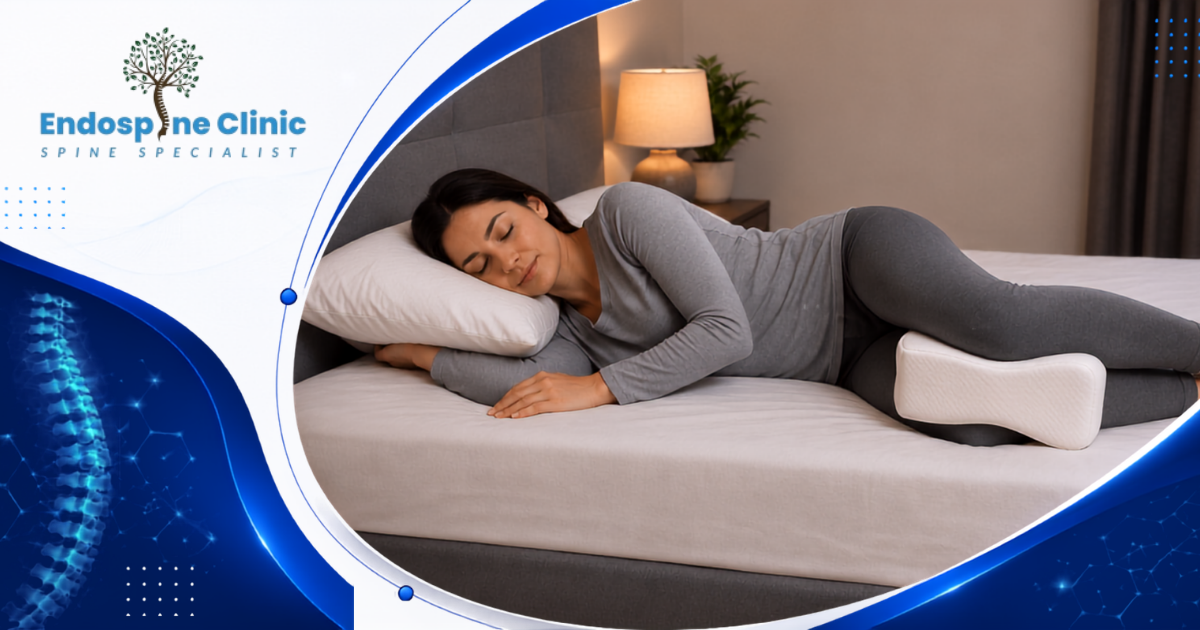
1. Side Sleeping with a Pillow Between Your Knees
If you love sleeping on your side, this is the most effective adjustment you can make.
-
The Setup: Lie on your side with your knees slightly bent.
-
The Pillow Placement: Place a firm pillow horizontally between your knees and upper thighs.
-
Why it Works: The pillow prevents your upper leg from collapsing downward. This keeps your hips, pelvis, and spine perfectly parallel to the mattress.
-
Pro Tip: Make sure your head pillow is thick enough to fill the gap between your neck and the mattress, keeping your head level.
2. Back Sleeping with a Pillow Under Your Knees
Sleeping on your back evenly distributes your body weight across the widest surface area. However, lying completely flat can sometimes strain the lower back.
-
The Setup: Lie flat on your back looking straight up at the ceiling.
-
The Pillow Placement: Slide a medium-to-large rolled pillow or bolster directly under your knees.
-
Why it Works: Elevating the knees slightly flattens the lumbar curve just enough to remove pressure from the lower spinal joints. It allows the back muscles to release their tension completely.
-
Pro Tip: You can also place a small, rolled-up towel under the small of your back for extra lumbar support.
3. The Reclined Back Sleeping Position
If you suffer from isthmic spondylolisthesis (a condition where one vertebra slips over another), sleeping in a reclined position can be highly beneficial.
-
The Setup: Elevate your upper body to a 30-to-45-degree angle.
-
The Pillow Placement: Use a wedge pillow behind your back and head, or sleep in an adjustable bed. Keep a small pillow under your knees.
-
Why it Works: Reclining opens up the angle between your torso and thighs, reducing the pressure on your lower spine and easing nerve compression.
4. Stomach Sleeping with a Pelvic Pillow (For Stubborn Stomach Sleepers)
If you absolutely cannot fall asleep in any other position, you must modify your stomach sleeping habit to protect your spine.
-
The Setup: Lie on your stomach.
-
The Pillow Placement: Place a thin, flat pillow underneath your pelvis and lower abdomen.
-
Why it Works: This elevates your hips just enough to restore the natural curve of your lower back, preventing it from sinking deeply into the mattress.
-
Pro Tip: Try sleeping without a pillow under your head, or use an exceptionally thin one, to avoid craning your neck backwards.
Essential Sleep Hygiene Tips for Spine Health
Beyond mastering the right sleeping positions for lower back pain, your overall sleep environment plays a crucial role in your recovery.
Invest in the Right Mattress A mattress that is too soft will cause your spine to sag like a hammock. A mattress that is too hard will push against your pressure points, throwing you out of alignment. Medium-firm mattresses are generally recommended for optimal back support.
Log-Roll Out of Bed How you get out of bed matters just as much as how you sleep. Never sit straight up from a flat position. Instead, roll onto your side, drop your legs over the edge of the bed, and use your arms to push yourself up sideways.
Stay Hydrated Your spinal discs are filled with fluid. Staying hydrated throughout the day helps these discs rehydrate and plump up while you sleep, providing better shock absorption for the next day.
Advanced Spine Treatment in Vadodara

When conservative home methods fail, seeking professional spine treatment in Vadodara offers a pathway back to a pain-free life.
The medical infrastructure in Vadodara provides patients with state-of-the-art diagnostic tools, including high-resolution MRI and CT scans, to accurately pinpoint the source of the pain.
Non-Surgical Treatments Most back pain can be resolved without surgery. Your specialist may recommend targeted physical therapy, epidural steroid injections, or advanced chiropractic adjustments to restore mobility.
Minimally Invasive Spine Surgery If surgery is required, you are in good hands. The best spine surgeon in Vadodara will likely utilize minimally invasive techniques. These procedures use tiny incisions, resulting in less muscle damage, faster recovery times, and minimal scarring compared to traditional open surgeries.
Patients travel from across the region to Vadodara because of the high trust factor, affordable healthcare costs, and the presence of board-certified, internationally trained spine surgeons.
The Benefits of Correcting Your Sleep Posture
Taking the time to adjust your nighttime habits yields incredible benefits for your daily life.
-
Faster Recovery: Proper alignment increases blood flow to injured tissues, accelerating natural healing.
-
Increased Energy: Waking up without pain means you achieve deeper, more restorative REM sleep.
-
Improved Daily Posture: Training your spine to be neutral at night naturally improves your posture while sitting and standing during the day.
-
Prevention of Chronic Conditions: Good sleep posture reduces the wear and tear on your spinal discs, preventing premature degeneration.
Frequently Asked Questions (FAQs)
1. What are the best sleeping positions for lower back pain? The most effective positions are sleeping on your side with a pillow between your knees, or sleeping flat on your back with a pillow tucked under your knees. Both methods maintain the spine’s natural curve.
2. How do I know if I need spine treatment in Vadodara? If your lower back pain lasts for more than a few weeks, radiates down your legs, causes numbness, or severely disrupts your sleep despite postural changes, you should consult a specialist locally for a proper diagnosis.
3. Is it bad to sleep on your stomach if you have back pain? Yes. Stomach sleeping is highly discouraged as it flattens the natural lumbar curve and strains the neck. If you must sleep this way, place a thin pillow under your pelvis to lift your hips.
4. How can I find the best spine surgeon in Vadodara? Look for a board-certified orthopedic or neuro-spine surgeon with excellent patient reviews, a strong track record in minimally invasive procedures, and affiliations with top-tier hospitals in the city.
5. Can a bad mattress cause lower back pain? Absolutely. An unsupportive mattress forces your spine out of alignment. If your mattress is older than 7-10 years or visibly sagging, upgrading to a medium-firm option can significantly reduce your nighttime pain.
Conclusion
Your sleep should be a time of healing, not a source of suffering. By consciously adjusting your nighttime habits and utilizing strategic pillow placements, you can drastically reduce the stress on your lumbar spine.
Remember that optimizing your sleeping positions for lower back pain is an ongoing practice. It may take a few nights for your body to get used to a new posture, but the long-term relief is well worth the effort.
Do not let chronic pain dictate your quality of life. Take action today by improving your sleep hygiene and reaching out to local medical experts who can guide you toward complete recovery.
Ready to Wake Up Pain-Free?
If adjusting your sleep position hasn’t resolved your persistent back aches, it is time for a professional evaluation. Do not ignore the warning signs your body is sending you.
Book a consultation with the best spine surgeon in Vadodara today. Get an accurate diagnosis, explore advanced minimally invasive treatments, and take the first step toward a healthier, pain-free life. Contact our clinic now to schedule your appointment!
